

There is a moment, just before you fully register the scale of the Hagia Sophia, when the building seems to withdraw rather than announce itself. The exterior gives little away, its mass softened by time, its details shaped by centuries of repair and adaptation. Then you step inside, and the space opens all at once. What follows is not simply visual awe, but a deeper awareness of history pressing gently from every surface.
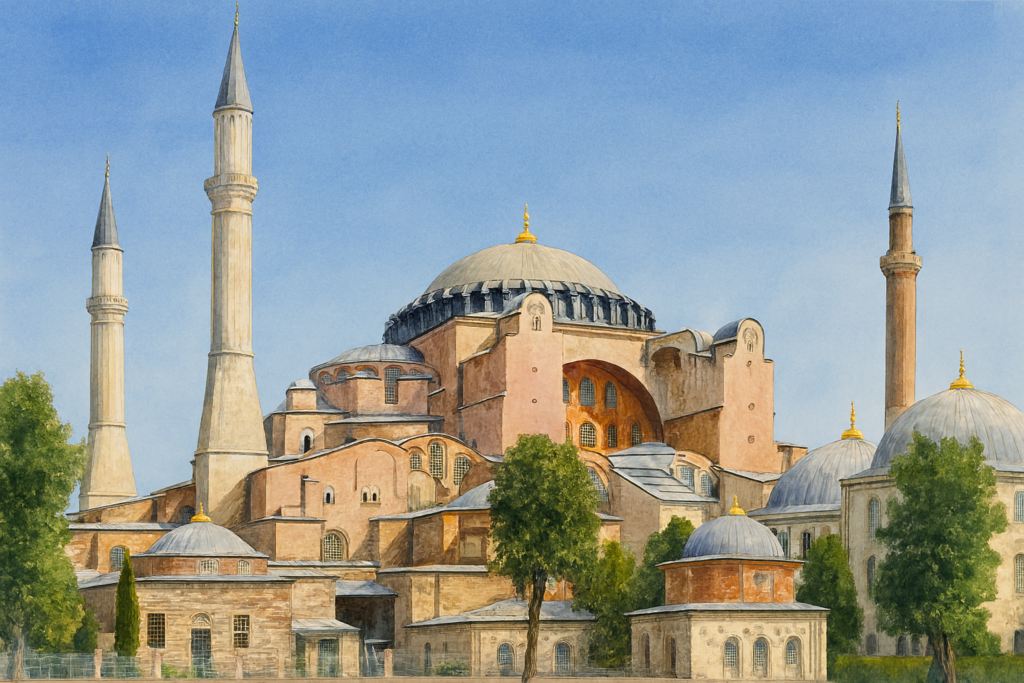
Built in the sixth century under Emperor Justinian I, the Hagia Sophia was conceived as the crowning achievement of the Byzantine Empire, an architectural declaration of faith, authority, and innovation. Its vast central dome still defies expectation. Suspended above the space through the revolutionary use of pendentives, it appears to float rather than rest. A ring of windows at its base allows light to filter inward, softening the structure and blurring the boundary between mass and atmosphere. Standing beneath it, the scale is not oppressive. It is enveloping.
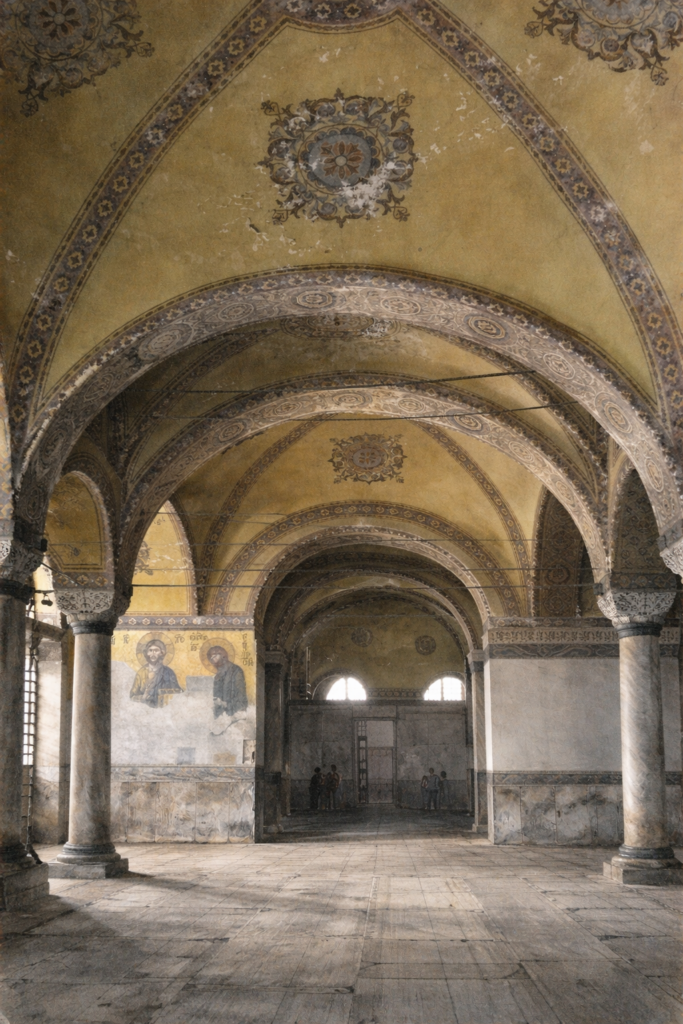
The interior unfolds with quiet complexity. Marble columns sourced from across the empire line the space, their veining expressive and intentional. Surfaces shift from cool stone to shimmering gold, where mosaics hover high above, worn and incomplete, yet deeply resonant. These fragments do not feel diminished by time. Their partial presence carries as much meaning as their survival, offering glimpses into a spiritual and artistic world that once defined the space.
The transformation of the Hagia Sophia into a mosque in the fifteenth century introduced new layers rather than erasing the old. Large medallions bearing Islamic calligraphy now hang alongside Byzantine mosaics, suspended in careful balance. Minarets rise outside, reshaping the skyline, while inside the space remains grounded in its original geometry. The building does not attempt to reconcile its identities. It holds them together, allowing each to exist without dominance or apology.
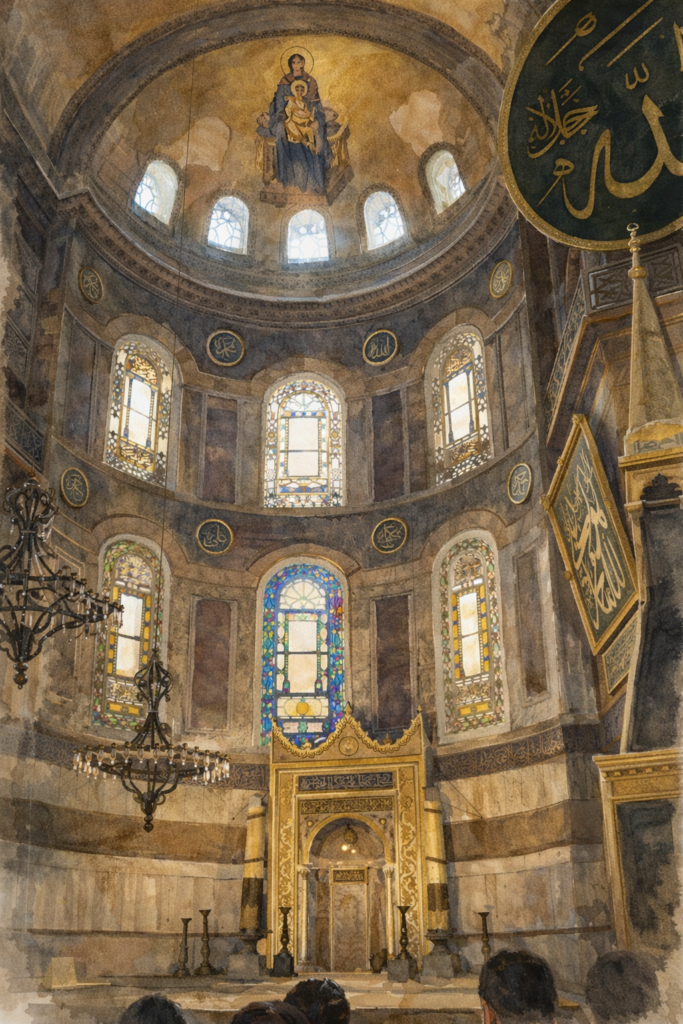
Sound moves through the Hagia Sophia with the same deliberation as light. Footsteps echo softly across stone floors. Voices rise and dissipate before they fully settle. The scale encourages quiet, not through force, but through proportion. Every surface, every curve, every measured transition reinforces a sense of orientation toward something larger than the individual, whether understood as faith, history, or collective memory.
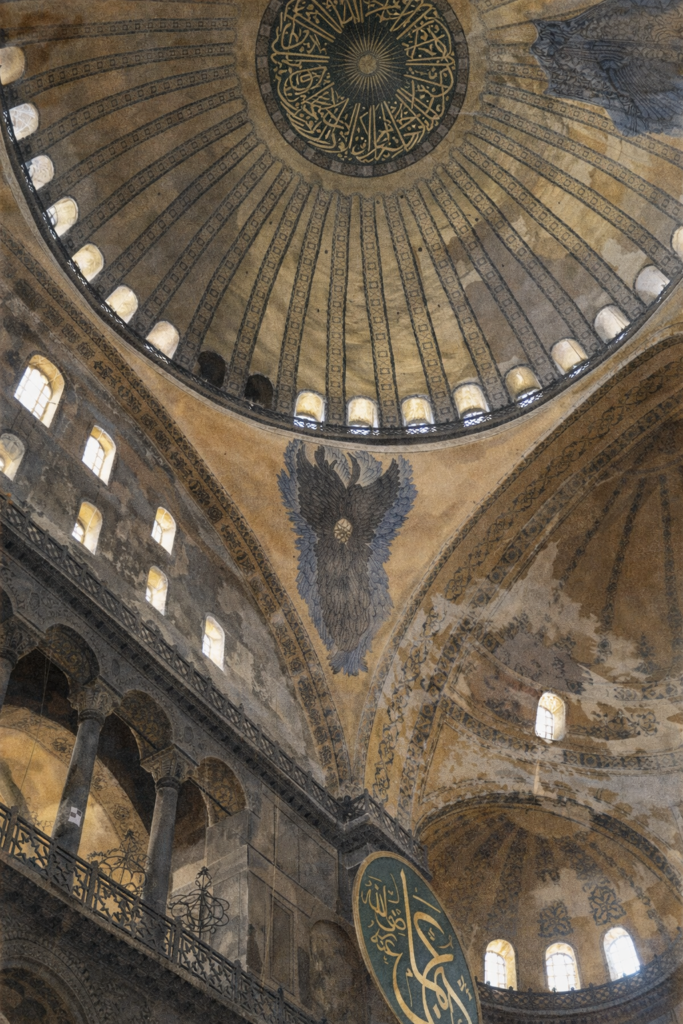
Moving through the upper galleries, I became aware of the countless lives that have passed through this space. Worshippers, rulers, scholars, and visitors, each shaped by the building in ways both subtle and profound. The Hagia Sophia has endured earthquakes, political shifts, and centuries of reinterpretation. It has changed, yet it has never been emptied of meaning. Instead, it has absorbed each era, allowing time itself to become part of its architecture.
Leaving the Hagia Sophia, the sense of withdrawal lingered. The building does not send you away with spectacle or resolution. Instead, it recedes slowly, allowing its weight to settle after you have stepped back into the city. What remains is not a single image or detail, but an awareness of having passed through something held together by time, adaptation, and restraint. The Hagia Sophia does not ask to be understood all at once. It waits, layered and patient, carrying history not as a proclamation, but as a presence.