
I boarded the Mount Washington Cog Railway with the same quiet anticipation I usually feel when entering a new city, the sense that I am about to be lifted out of the familiar and placed somewhere that demands attention. By trade and temperament, I am drawn to systems, how things are built, how they endure, how they respond to forces beyond their control. As the train began its steady climb up the White Mountains, I realized this journey would be less about destination and more about exposure.
The cog railway feels almost reverent in its engineering. It does not rush or dramatize the ascent. Instead, it clicks forward with patience and resolve, engaging the mountain rather than attempting to dominate it. From my seat, I watched dense forest give way to rock and scrub, the landscape stripping itself down as the incline steepened. It reminded me of cities at their edges, where ornament fades and infrastructure tells the truer story. Here, the structure is the experience.

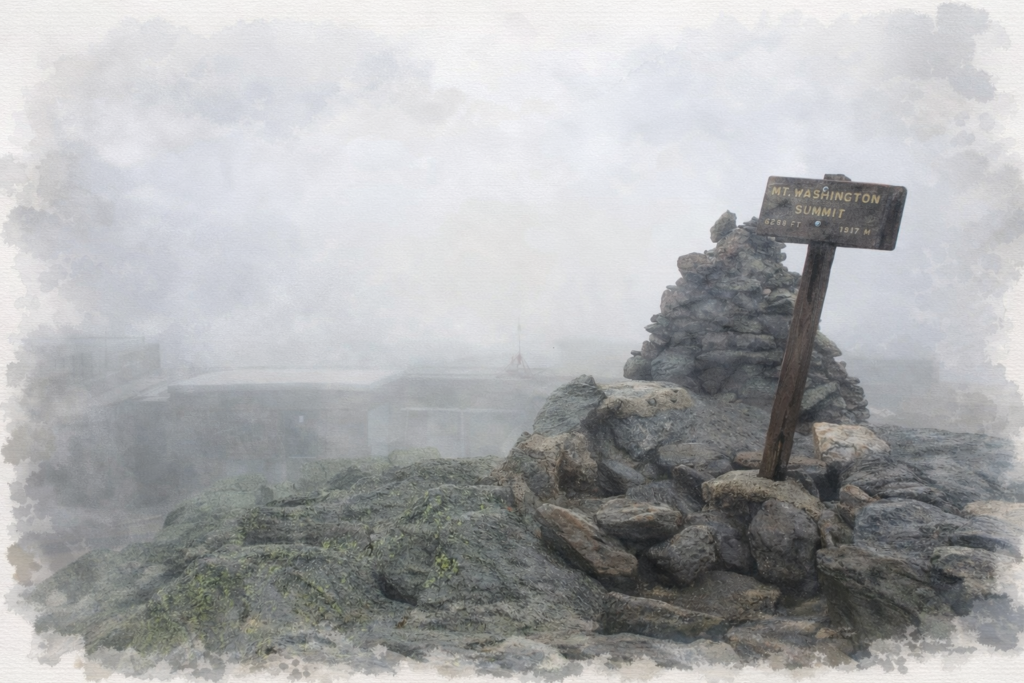
Weather quickly became the defining character of the trip. Clouds rolled in thick and low, blurring the horizon until depth and distance dissolved entirely. By the time we reached the summit, the wind was blowing wildly, relentless and almost theatrical, pushing rain sideways through heavy fog. The temperature hovered in the forties, sharp enough to cut through layers. Visibility was minimal, but the atmosphere was overwhelming in the best way. The mountain was not offering views. It was offering presence.
At the top, everything felt raw and uncompromising. The summit buildings stood firm but unadorned, designed purely for survival rather than comfort. I appreciated their honesty. There was no attempt to soften the conditions or pretend the environment was anything other than hostile. Standing there, braced against the wind and mist, I felt a rare clarity, the kind that comes when distraction is stripped away and you are left only with sensation and scale.
The descent was quieter and more reflective. As the train eased its way back down, I thought about why places like this resonate so deeply with me. In cities, I wander to feel alive, to notice textures, thresholds, and small moments that might otherwise be overlooked. On Mount Washington, the scale was larger and the conditions harsher, but the lesson felt similar. Good design, like good travel, acknowledges context. It responds. It does not fight what already exists.
Not every meaningful journey is sunny or picturesque. Sometimes it is foggy, cold, and loud with wind. Sometimes the view is obscured, and that is exactly the point. You leave with a sharpened awareness, not just of place, but of how thoughtfully we can move through environments that are far more powerful than we are.